
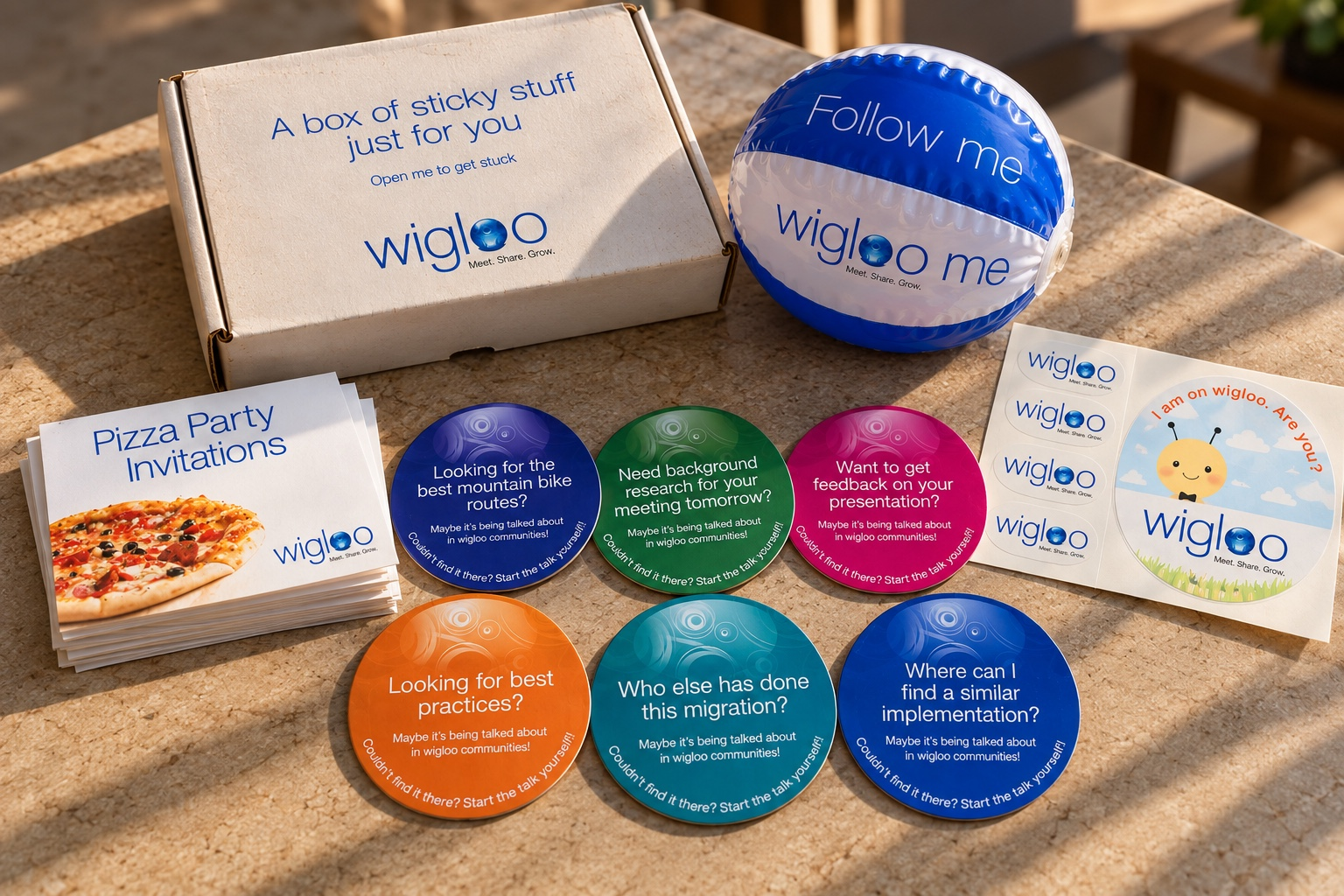
It is white, with the Wigloo logo on the front and “Meet. Share. Grow.” underneath. Inside were some of the things we used when we launched the platform at Amdocs: stickers, invitations, round coffee-cup coasters printed with questions, and other pieces intended to get people to try it.
More than fifteen years later, the contents make the product problem unusually concrete.
Wigloo was an internal social platform we built at Amdocs around 2010. Internal Communications initiated the effort as part of a broader push around cooperation, alignment and company culture. Social networking was becoming an increasingly visible part of how people connected outside work, and the question was what that behavior could mean inside a large enterprise.
The name was intentional: Wigloo echoed “we glue,” which captured the product ambition well: connecting people to one another, to communities and to knowledge they could use.
We evaluated products emerging in the market and chose to build on the SharePoint environment Amdocs already used. I no longer remember the vendor comparison well enough to reconstruct it here.
The starting point was SharePoint’s communities and profiles capabilities, but Wigloo involved substantial customization and development around them.
The underlying problem was familiar. At Netwise, I had worked on enterprise portals and collaboration and knowledge-management solutions. Different projects used different mechanisms, but the recurring need was similar: make useful information easier to find, connect it to the people who understood it, and help others use it in their own work.
Wigloo pushed that problem toward a more people-centered model. Profiles, communities and conversations could sit alongside documents, search and formal knowledge stores. The question was no longer only where information lived; it was also who knew something about it and how to reach them.
Creating reasons to participate
Profiles and communities were part of the foundation. The product work also included Q&A, migration from existing forums, integrations, and subsequent versions and production work.
Deploying the software did not create the network. People still had to decide that there was something worth doing there.
One of the simplest things left in the box makes that concrete: a set of round coasters printed with questions.
Who else has done this migration? Where can I find a similar implementation? Where can I find best practices?
Those are work questions. They start with someone trying to solve a problem, not with someone looking for a reason to visit a social network.
Wigloo was meant to make it easier to reach relevant knowledge, experience, a community or a person—and to start a conversation when the answer wasn’t already there.
The launch also used ambassadors. They received training and physical material for introducing Wigloo within teams, including stickers and pizza-party invitations.
Participation was something we worked on explicitly, rather than something we expected the software to generate by itself.
The product behind the launch
The physical materials are memorable, but they were one layer of the work.
The product extended across the SharePoint-based foundation, profiles and communities, Q&A, forum migration, integrations and later production work. Activation sat alongside that product work rather than replacing it.
Wigloo — product scope and early evidence
Foundation
SharePoint-based foundation
Profiles
Communities
Product Work
Q&A
Forum migration
Integrations
Subsequent versions / production work
Activation
Ambassadors
Team activation
Professional questions
Reported in January 2011
5,000+
employee profiles
Hundreds
of professional communities
Dozens
of social communities
Wigloo combined a SharePoint-based foundation, product development and participation work. The January 2011 figures are a time-bounded snapshot of reported activity.
By January 2011, Calcalist reported more than 5,000 employee profiles, hundreds of professional communities and dozens of social communities. The article also described plans to continue developing Wigloo.
Those figures establish what matters for this story: employees were creating profiles and communities; Wigloo had moved beyond being merely a deployed system.
What the box still captures
Looking at the launch material now, what interests me most is how little of it asks people to care about Wigloo itself.
The coasters ask where to find experience, who has done a similar migration, where to find best practices, or who can give useful feedback.
The platform mattered because it could shorten the path between a question and the knowledge, experience or person that might help answer it.
I had encountered versions of that problem before Wigloo, and it has remained relevant in my work since. Good collaboration systems reduce the distance between someone trying to solve a problem and the knowledge or experience already present elsewhere in the organization.
More than fifteen years later, that is what the box still captures for me: a product trying to make useful knowledge—and the people behind it—easier to reach.